

You’ve seen them. On a water bottle in someone’s gym bag. Slapped on a laptop next to eleven other stickers that are all trying too hard. Catching the light on a mylar bag at exactly the angle that makes you go “wait, what was that.”
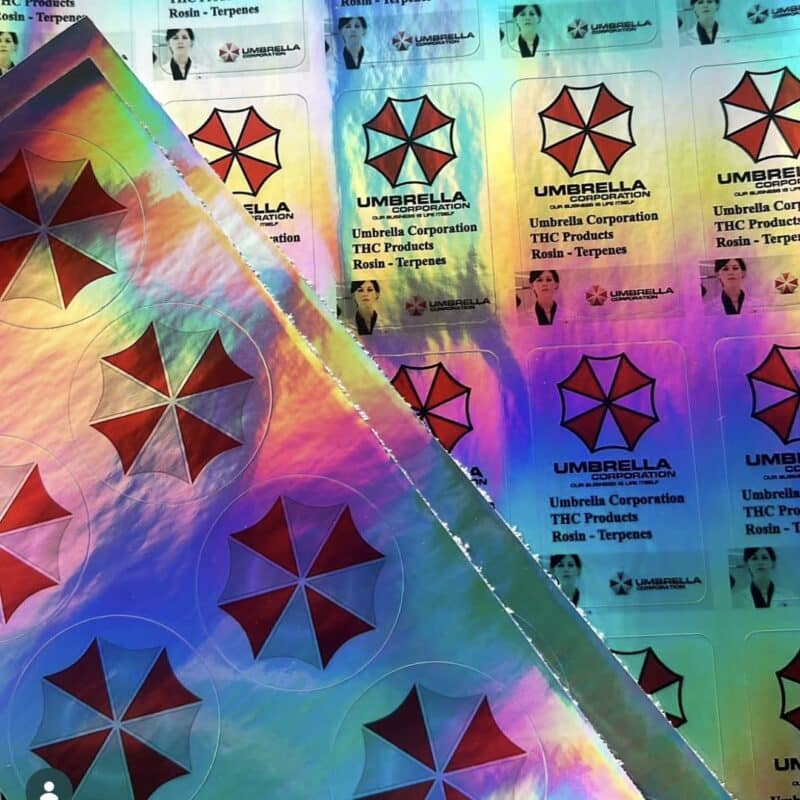
Holographic stickers went from “a bit Y2K” to “everywhere” in about eighteen months, and it’s not really a mystery why. They do a thing that no other sticker does: they change. Tilt a matte sticker and it just sits there being matte. Tilt a holographic one and it throws a rainbow across the room like it’s got somewhere to be. That’s not a marketing angle, that’s just what the material physically does, and humans are hardwired to look at things that move.
The question isn’t whether they look good. They do. The question is whether they’re actually right for your packaging, or whether you’re about to spend money making your bag look like a school disco.
What they’re actually good at
Holographic works when your product needs to win a fight for attention it’s currently losing. Think a shelf full of near-identical pouches, a market stall next to four other stalls selling roughly the same thing, or a delivery box that has to compete with the eleven other cardboard boxes stacked on someone’s doorstep. A holographic label doesn’t ask to be noticed. It just is.
It’s also doing a lot of quiet flattering. Slap custom holographic stickers on a logo and it stops reading as “small batch, made in a spare room” and starts reading as “this brand has its act together.” Rightly or wrongly, shine reads as investment. That’s genuinely useful if you’re a newer brand trying to look established before the bank balance catches up.
What it’s not good at
Subtlety. If your whole brand is built around a calm, minimal, “we don’t shout” aesthetic, holographic will fight you every step of the way. It’s a finish with an opinion, and that opinion is look at me. Fine if that’s the plan. Actively wrong if it isn’t.
It’s also not the move if you’re printing dense text or fine detail — small type, thin linework, anything that needs to be read quickly rather than admired. The rainbow shift that makes a logo pop can turn a paragraph into a genuine eye strain. Save the holographic stock for the hero mark or the badge, and let a clean vinyl or matte finish do the actual talking elsewhere on the pack.
The honest comparison
Standard vinyl stickers are the dependable one — flat colour, reads clearly at any size, doesn’t fight your design, cheaper per unit, and honestly still the right call for most day-to-day branding. Nobody ever regretted a clean vinyl logo sticker.
Custom holographic stickers are the ones you reach for when you specifically want the “wait, what was that” moment — a limited drop, a flagship product, the one SKU you actually want people photographing. Used everywhere, they lose their power fast. Used on the one thing that deserves it, they’re genuinely hard to beat.
If you want the shine without going full disco ball, a die-cut sticker in holographic — cut tight to your logo shape rather than a plain circle or square — tends to land the best of both: still eye-catching, but considered rather than chaotic.
So, worth it?
If your packaging currently blends into a shelf, yes, probably. If your brand is already doing the “quiet and expensive” thing well, maybe skip it, or use it sparingly on one accent detail rather than the whole label. And if you’re still not sure — order a small batch first. Fifty holographic stickers costs you very little to find out whether your customers lose their minds over it or politely ignore it. That’s a much cheaper way to find out than guessing and printing two thousand.
Either way: your packaging is doing marketing whether you’ve thought about it or not. Might as well make it earn its keep.